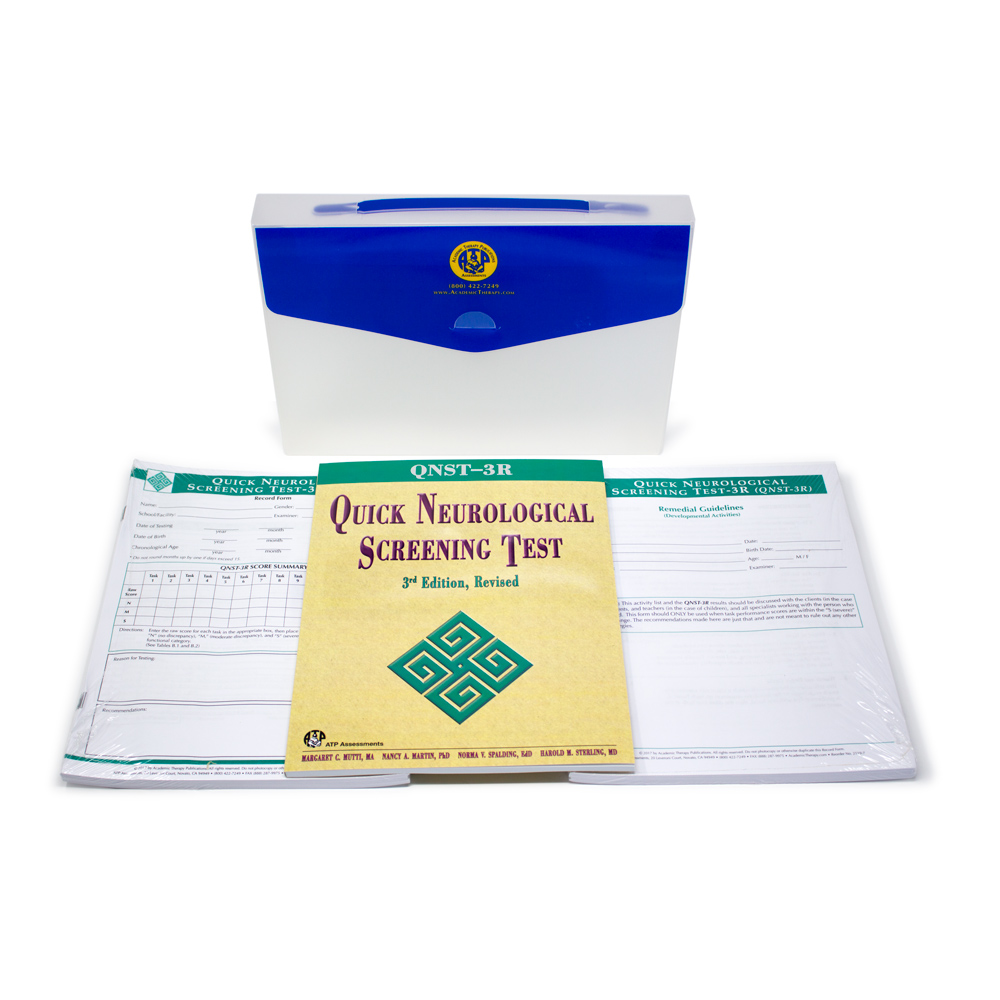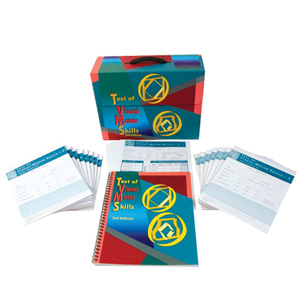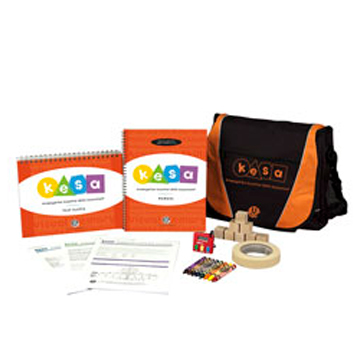

Test Kit Includes: Manual, 25 Record Forms, 25 Design Completion Worksheets, 1 set of 5 Stimulus Cards, stopwatch, pencil and pencil topper, in portfolio
Replacements/Extras:
• 25 Record Forms
• 1 set of 5 Stimulus Cards
• Manual
• 25 Design Completion Worksheets
VSA-2 Items:
• Pursuits (Object Tracking) - Assess the child's ability to smoothly track vertically, horizontally, and in a circle.
• Scanning (Trails) - Assess the child's ability to accurately and efficiently visually follow intersecting lines between two points.
• Aligning (Push-Ups) - Assess the child's near point of convergence and screen for strabismus and phorias.
• Locating/Saccadic Eye Movements (Numbers) - Assess the child's ability to accurately and efficiently move the eyes between two visual targets.
• Eye-Hand Coordination (Design Completion) - Assess the child's ability to accurately complete six unfinished forms when presented with a visual model to copy.
• The VSA-2 was standardized on a nationally representative sample of 1,000 individuals ages 5.0 through 14.11.
Administration and Scoring
The VSA-2 can be administered in 10-15 minutes and scored in 5. Detailed examples are provided in the manual to assist with scoring the Design Completion items. Raw scores are converted to an Overall standard score and percentile rank. Individual items and time scores can be further analyzed using frequency tables.
Reliability and Validity
Average Cronbach's Alpha value across all ages was 0.72.
Test-retest correlation was 0.80.
Interrater reliability correlation was 0.91.
Validity studies demonstrated that the VSA-2 is able to identify visual skills challenges in children with specific learning disability, dyslexia, and autism spectrum disorder, and is able to differentiate typically developing children from those with a known visual efficiency disorder.
Replacements/Extras:
• 25 Record Forms
• 1 set of 5 Stimulus Cards
• Manual
• 25 Design Completion Worksheets
VSA-2 Items:
• Pursuits (Object Tracking) - Assess the child's ability to smoothly track vertically, horizontally, and in a circle.
• Scanning (Trails) - Assess the child's ability to accurately and efficiently visually follow intersecting lines between two points.
• Aligning (Push-Ups) - Assess the child's near point of convergence and screen for strabismus and phorias.
• Locating/Saccadic Eye Movements (Numbers) - Assess the child's ability to accurately and efficiently move the eyes between two visual targets.
• Eye-Hand Coordination (Design Completion) - Assess the child's ability to accurately complete six unfinished forms when presented with a visual model to copy.
• The VSA-2 was standardized on a nationally representative sample of 1,000 individuals ages 5.0 through 14.11.
Administration and Scoring
The VSA-2 can be administered in 10-15 minutes and scored in 5. Detailed examples are provided in the manual to assist with scoring the Design Completion items. Raw scores are converted to an Overall standard score and percentile rank. Individual items and time scores can be further analyzed using frequency tables.
Reliability and Validity
Average Cronbach's Alpha value across all ages was 0.72.
Test-retest correlation was 0.80.
Interrater reliability correlation was 0.91.
Validity studies demonstrated that the VSA-2 is able to identify visual skills challenges in children with specific learning disability, dyslexia, and autism spectrum disorder, and is able to differentiate typically developing children from those with a known visual efficiency disorder.